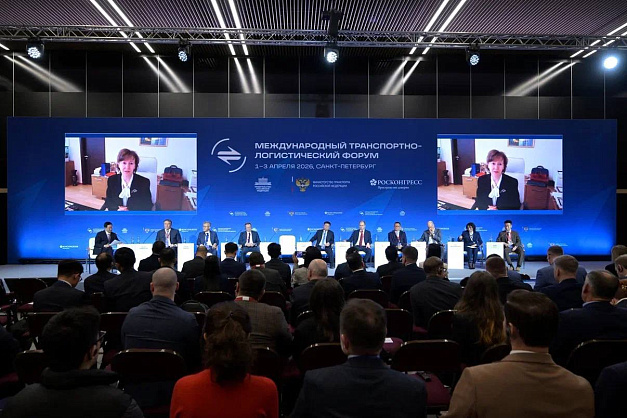
Non-resource, non-energy exports from Russia to China increased by 18% in 2025, said Veronika Nikishina, Director General of Russian Export Center (REC, VEB.RF Group), at the International Transport and Logistics Forum in St. Petersburg.
"Despite a slight fluctuation in the figures for 2025, non-resource exports increased by 18%. In addition to the usual fuel, meat, seafood, confectionery, chemical and forest products, high-tech and light industry products are also exported to Chinese consumers. These aren't just figures. They're an answer to the question of how to diversify the economy. And the Chinese market is our key partner here," Veronika Nikishina at the Russia-China Cooperation in Logistics: Current Status, Key Achievements, and Development Vectors session, co-organized by Russian Export Center.
Speaking about the Made in Russia program, the head of REC noted that promoting domestic goods under a single national brand creates a comprehensive distribution infrastructure in China, allowing Russian manufacturers to feel at home thanks to the REC's permanent representative office, regular festivals and fairs, pavilions, and collaboration with major marketplaces.
"The results are clear: Chinese consumers are becoming increasingly familiar with our dairy products, meat, chocolate, and baby food. Demand is growing, and logistics must keep pace with it,"Veronika Nikishina.
The head of Russian Export Center (REC) highlighted the new architecture for shipping goods from Russia to China. This includes direct container trains through Kazakhstan and Mongolia, the modernization of terminals in Zabaikalsk, Artiom, and Kani-Kurgan, and the transition of maritime shipping from complex transit to direct routes. Meanwhile, Chinese ports have become a key hub for Russian exporters entering the markets of Southeast Asia.
Veronika Nikishina also noted that a special supply route to China, Export Express for SMEs, has been established for small exporting companies in Russia. This route consists of regular dispatches of container trains, which collect small shipments from small and medium-sized businesses, each weighing up to one container. The trains travel directly to key distribution centers in Xi'an, Qingdao, Chengdu, and Suifenhe. There, manufacturers can store their goods on preferential terms and sell them even from a single lot.
"We've dispatched over 38 such trains since we launched. The products range from frozen meat and confectionery to chemical products," Veronika Nikishina.
In the context of food supply, the "Fish" and "Meat" shuttles stand out as successful logistics solutions.
"We've created end-to-end multimodal services operating without seasonal restrictions. The results are impressive: while in 2024 we shipped 130,000 tons of products to East Asia (primarily China), in 2025 that number has already increased to over 200,000 tons. This clearly demonstrates that favorable economics of the route and direct cooperation with manufacturers in the region are driving exponential growth," Veronika Nikishina.
Growing trade turnover requires new solutions, so the head of Russian Export Center proposed that their Chinese partners synchronize the development of border infrastructure to address bottlenecks in the eastern direction at the Zabaikalsk, Makhalino, and Grodekovo crossings. This will increase throughput and the range of cargo handled.
Veronika Nikishina also proposed switching to a fully electronic document management system to expedite the integration of Russian and Chinese systems for the exchange of phytosanitary and veterinary certificates. This will simplify and expedite the supply of fish, meat, and poultry, products that are in high demand in China. The head of Russian Export Center believes that the logistics of trade between Russia and China should become paperless in multimodal shipments and rely on modern digital platforms.
The Northern Sea Route is a new alternative route that allows cargo to be delivered to ports in the Western Arctic and Northern Europe twice as fast as via the Suez Canal. Russia and China need joint investments in port infrastructure and the creation of joint ventures to manage this route.
"Our goal for 2026 is to transform the existing infrastructure into a stable, transparent tool that will allow our manufacturers to operate in the Chinese market with minimal costs," Veronika Nikishina.
Russian Export Center (REC, VEB.RF Group) is a government institution that supports non-resource, non-energy export. It provides companies from various industries with both financial and non-financial assistance at all stages of entering international markets, including as part of the International Cooperation and Export national project. Most services offered by the REC Group are available online on My Export digital platform. REC is responsible for the primary functions of supporting and implementing the Made in Russia program. The REC Group includes the Russian Agency for Export Credit and Investment Insurance (EXIAR), EXIMBANK OF RUSSIA, and the Export School.

В своем выступлении Мария Архипова подчеркнула важность национального бренда для укрепления
позиций российских предпринимателей на международной арене. «Наша главная задача — создать
условия, при которых продукция под брендом “Сделано в России” будет вызывать безусловное
доверие у зарубежных покупателей», — отметила она.
Show